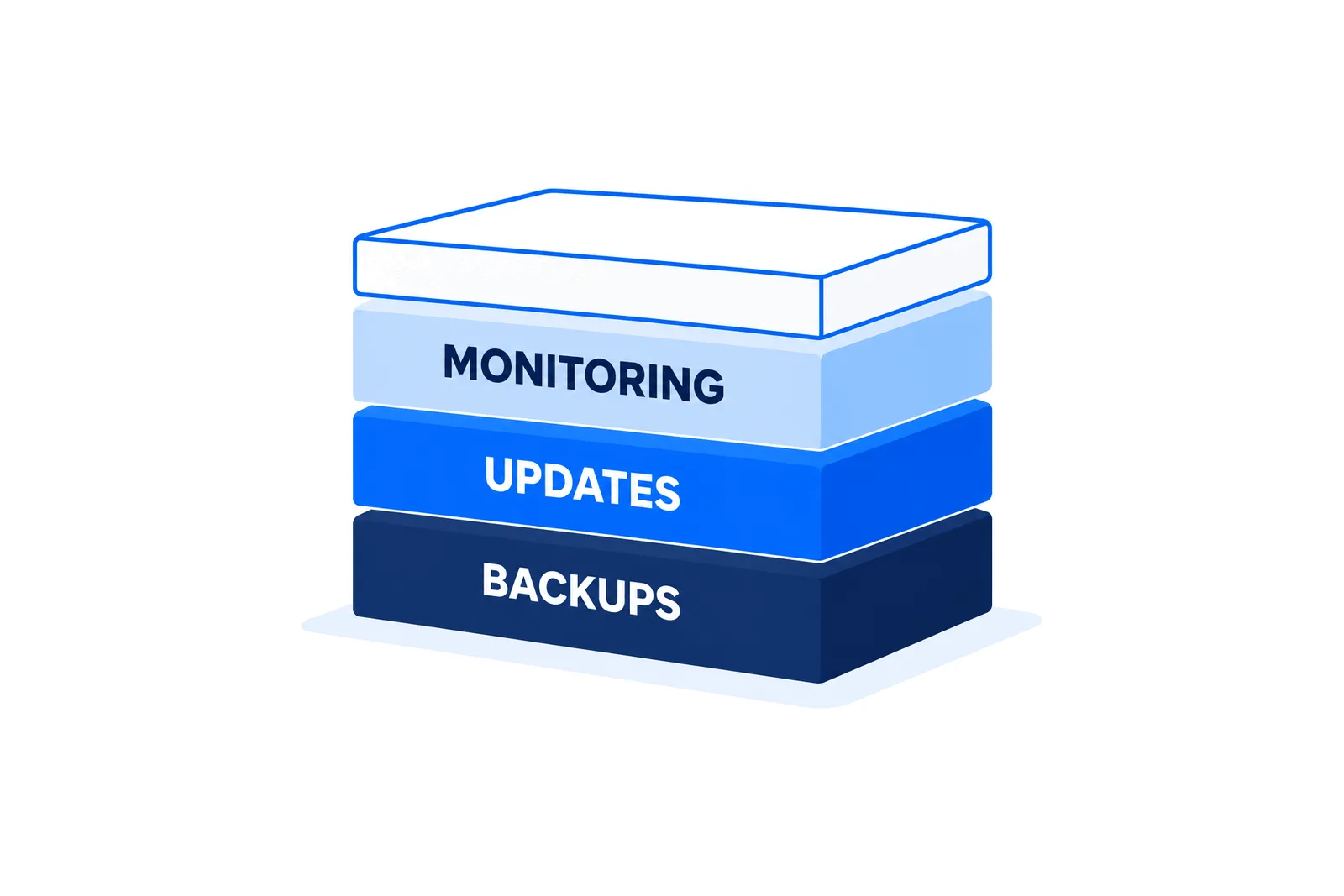
Website care plans are sold in a way that makes them almost impossible to compare. One provider charges $49 a month, another charges $400, and both descriptions say roughly the same words: updates, backups, security, support.
The difference is not the words. It is what happens when something goes wrong, who decides, and how fast. Here is how to read one.
What is genuinely required
A WordPress site left alone does not sit still. Core, themes and plugins all release updates, a meaningful share of them security fixes. An unmaintained site is not stable, it is accumulating known vulnerabilities that are published in public databases the moment they are patched.
So a care plan has to cover, at minimum:
- Updates applied and checked. Not just clicked. Checked afterwards, because updates break things.
- Backups taken off the server, and restorable. A backup stored only on the same host is not a backup, it is a copy.
- Uptime monitoring that alerts somebody who can act.
- Security patching on a schedule that matches severity, not the billing cycle.
- PHP version management, because hosts force these upgrades and a site that has not been tested against the new version simply stops.
That is the floor. Everything below is what actually varies.
The five questions that reveal the real difference
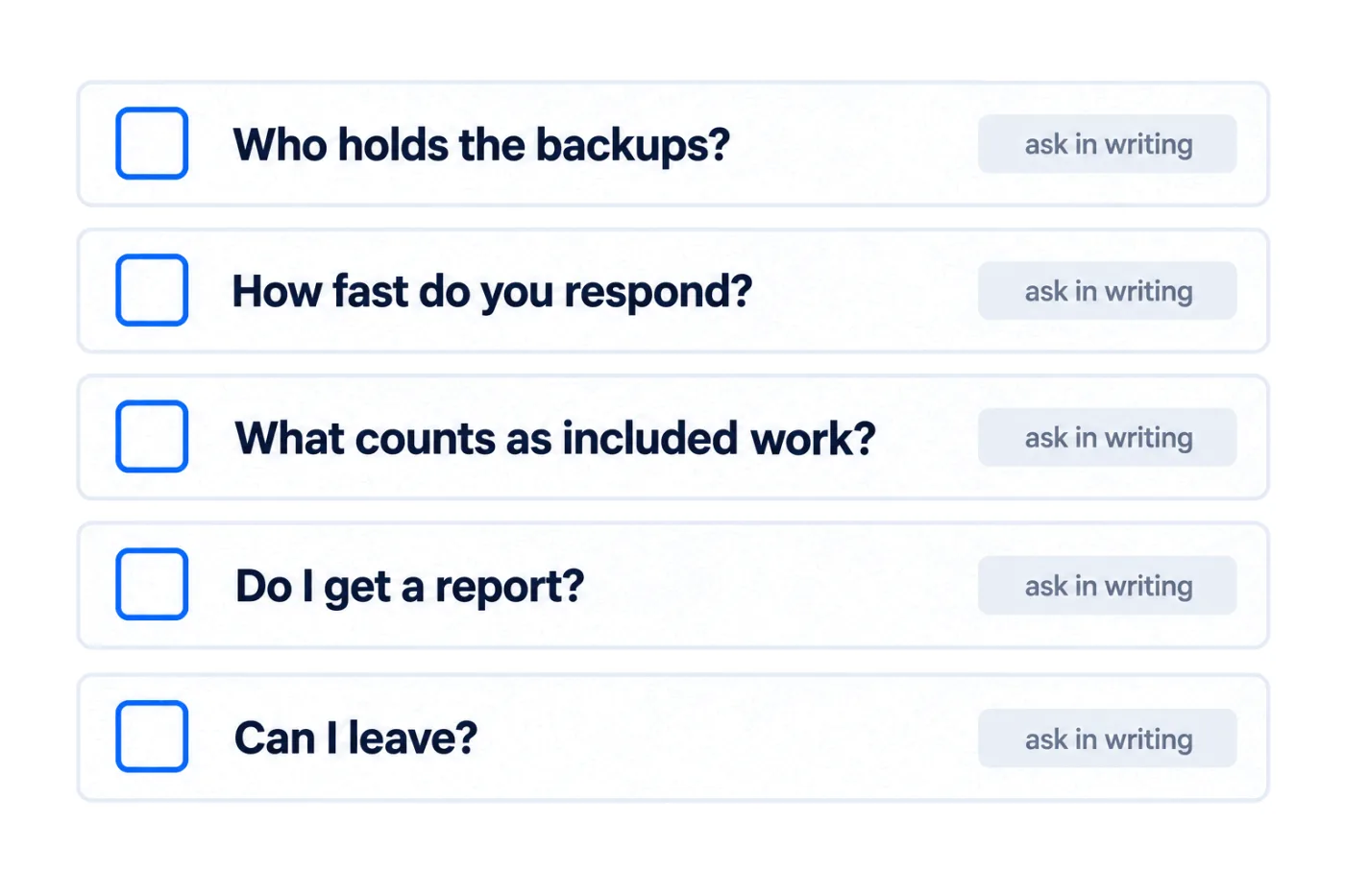
1. Who tests after an update, and against what?
The cheapest plans automate updates and hope. That works until a plugin update breaks the checkout, and nobody notices for nine days.
A real answer sounds like: updates go to staging first, these specific pages get checked, here is what we do if something breaks.
2. How fast, and does that promise have teeth?
"We will respond quickly" means nothing. Ask for hours. Ask what happens on a Saturday. Ask whether the response time covers acknowledging your message or fixing the problem, because those are very different commitments.
3. Is a hack covered, or is it extra?
This is the question that separates a maintenance contract from insurance, and most plans are quiet about it deliberately.
Some include cleanup. Some cover investigation but bill for remediation. Some exclude it entirely, which is a defensible position if it is stated plainly and a nasty surprise if it is not. There is no right answer, only a clear one.
4. What are the included hours actually for?
Many plans include a small monthly allowance of work. The useful question is what counts. Does answering an email count? Does a ten-minute content edit? Do the hours roll over, and for how long?
An allowance that expires monthly and gets consumed by admin is not an allowance.
5. What do you get if you leave?
Ask directly: if I cancel, do I get my backups, my hosting access, my domain, my licenses? In whose name are the plugin licenses registered?
The answer tells you whether you are buying a service or buying dependency.
What tends to be padding
A monthly PDF report nobody reads. Automated, generated by the same tool every agency uses, mostly green ticks. If the report is the deliverable, the deliverable is a report.
Uptime monitoring as a headline feature. This costs essentially nothing and takes minutes to configure. Charging for it as a distinct line item is padding.
"SEO monitoring" with no defined action. Watching a ranking number is not the same as doing anything about it.
A security plugin that scans and emails you. A scanner that notifies you of a problem you cannot fix has moved the work to you and called it a service.
The two structures, and who they suit
Care plans come in two shapes and they suit different people.
Break-fix with a retainer floor. You pay a smaller monthly amount for the essential maintenance, and pay hourly for anything beyond it. Cheaper when nothing happens. Unpredictable when something does.
Inclusive with a defined scope. A higher monthly amount covering both maintenance and a stated allowance of work, with the boundary written down. More expensive in a quiet month. Predictable, and much less friction about whether a given request is billable.
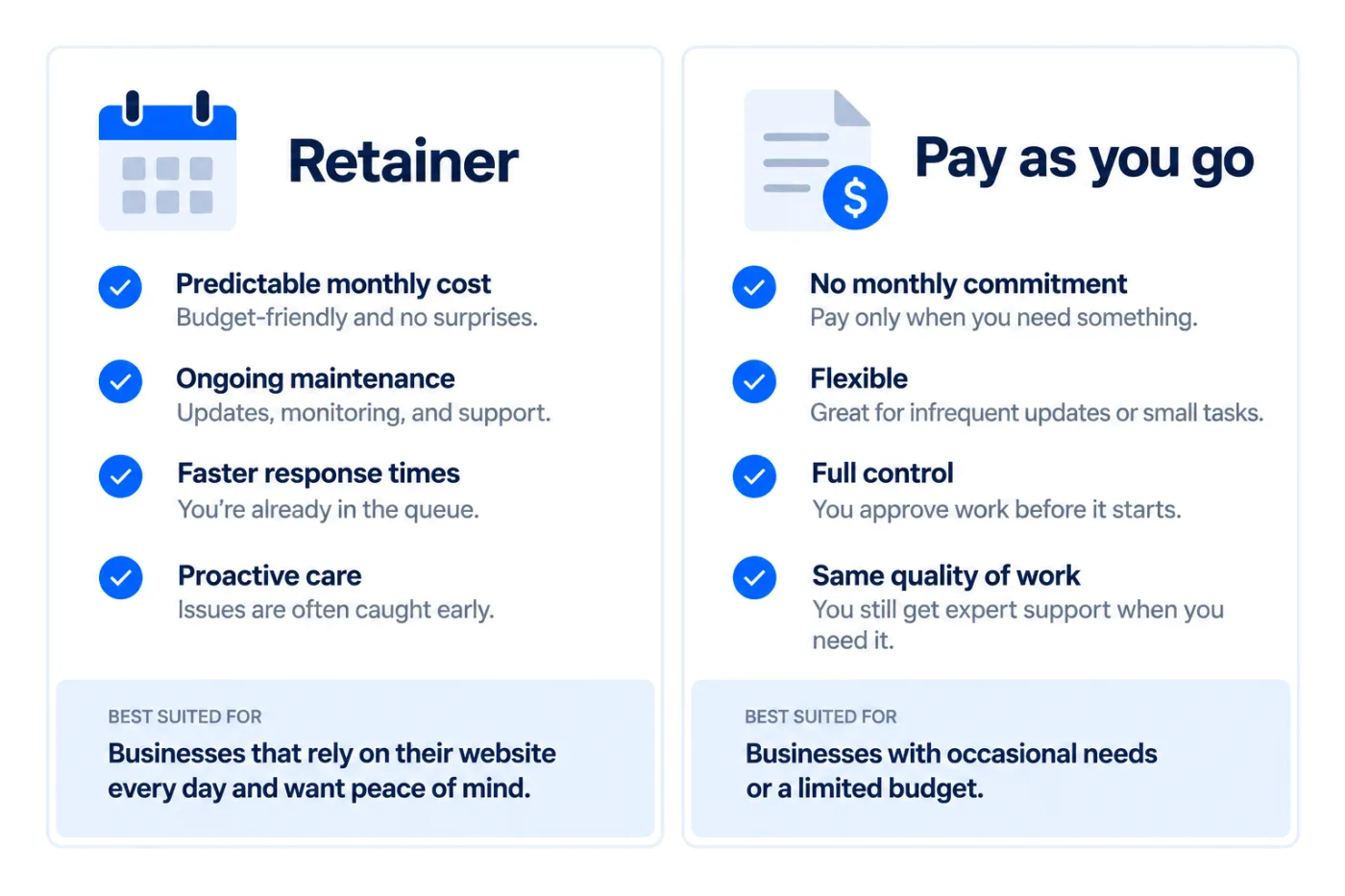
If your site is simple, changes rarely, and you are comfortable with the occasional invoice, the first one is fine. If your site is the front door to your business and you want a number in the budget, take the second.
What a reasonable price looks like
There is no single figure, but there are bands worth knowing.
Below about $50 a month, you are almost certainly buying automated updates and a backup plugin, with no human looking at anything. That is not fraud. It is worth what it costs, and it is not the same product as a plan with a person attached.
The middle ground is where most small business sites belong: maintenance plus a real allowance of work, with someone who knows the site and answers when you write.
Above that, you are usually paying for guaranteed response windows, larger work allowances, or genuine complexity in the site itself.
The number matters less than whether the scope is written down. A cheap plan with a clear boundary beats an expensive one with a vague promise.
The question underneath all of this
The real question is not what a care plan includes. It is who is responsible when the site is down at 9pm on a Sunday.
If the answer is "nobody, but there is a monitoring tool that will email you about it," you have bought monitoring, not care.
If the answer is a person who will pick it up and tell you what happened afterwards, that is the thing you are actually paying for, and it is worth more than any feature list.
If you want to see what that looks like written down rather than implied, the Website Care Plan page states the scope, the response time and what happens if you leave. Compare it against whatever else you are considering. The comparison is the point.