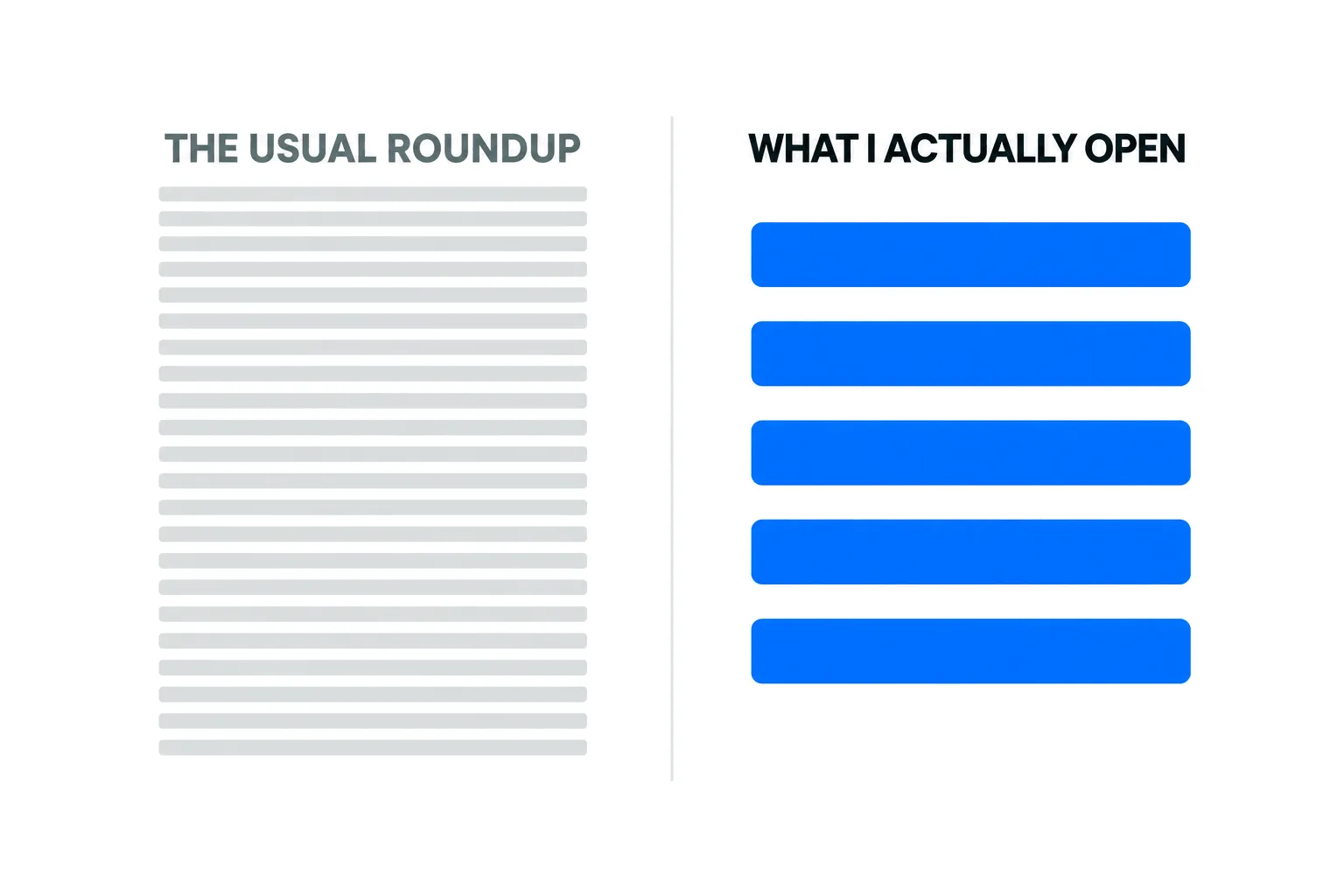
Most SEO tool roundups list forty products, because forty affiliate links pay better than six. This is the shorter version: the handful I actually open in a working week, what each is genuinely good at, and the point where the free tier stops being enough.
Prices are as of September 2026 and they move. Verify before you buy.
Start here, and it is free
Google Search Console. If you use one tool, use this one. It is the only source of first-party data about how your site actually performs in Google: the exact queries you appear for, your position on each, which pages Google has indexed and which it has refused, and why.
Every paid tool in this article estimates what Search Console tells you for certain. Nobody should be paying for keyword estimates on a site whose Search Console they have not read.
Set it up, wait sixteen months, and you will know more about your own site than any subscription can tell you.
Google Analytics 4. Not a joy to use, and the only free way to know what people do once they arrive. Pair it with Search Console and connect the two in GA4's admin so you can see search queries alongside behavior.
PageSpeed Insights. Free, no account, and it reports real user data from Chrome rather than a lab test, which is the number that actually counts.
Those three cover the majority of what a small site needs. Everything below is for when you have outgrown them.
The crawler: Screaming Frog
$279 a year. Free up to 500 URLs.
This is the tool I would keep if I could only keep one paid thing. It crawls your site the way a search engine would and hands you a spreadsheet of every problem: broken links, redirect chains, missing titles, duplicate descriptions, orphaned pages, pages returning the wrong status code, images with no alt text.
The free version handles 500 URLs, which is a genuine small business site, not a crippled demo. Most people reading this never need the license.
Buy it when your site is bigger than 500 pages, or when you are doing a migration and need to compare a full crawl before and after. That second case alone is worth the money once.
The big platforms: Ahrefs and Semrush
Ahrefs starts at $29 a month for a limited Starter tier, then jumps to $129 a month for Lite. Semrush starts at $139 a month. Both go up steeply from there.
These are the two everyone means when they say "an SEO tool". They do broadly the same jobs: keyword research with volume estimates, competitor analysis, backlink data, rank tracking, site audits.
What they are genuinely good at is competitive intelligence. Finding out what a competitor ranks for that you do not, where their links come from, and which pages produce their traffic. Search Console cannot tell you anything about anyone else's site. This is the gap these fill, and it is a real gap.
What they are not good at is being worth $1,500 a year to a business with one location and eleven pages. That is the honest version. If your entire competitive set is four local firms, you can learn what you need by looking at their sites for an hour.
Ahrefs' backlink data is the better of the two, and it is the reason to pick it. Semrush is broader, covering paid search and social alongside SEO, and it suits an agency managing several accounts better than it suits a single business.
Practical advice: subscribe to one of them for a month, do all your research at once, export everything, and cancel. Two months a year of Ahrefs beats twelve months of not quite using Semrush. Neither company will like reading that and it is what I would tell a friend.
Keyword volumes without a subscription
Keywords Everywhere sells credits rather than a monthly seat, and shows search volumes inline on Google and a dozen other sites. For occasional research it is dramatically cheaper than a platform subscription.
It now also gates SEO Minion, the page inspection extension that used to be free, behind its Silver plan and above. If you were looking for SEO Minion and wondering where the free version went, that is where.
Google Keyword Planner remains free with any Google Ads account, including one that never runs an ad. Its volumes are bucketed into ranges rather than exact, which is less useful than it sounds but perfectly adequate for deciding whether a topic is worth writing about.
Local search
If your business depends on the map results, the platforms above are mostly the wrong tool. What matters is your Google Business Profile, your review flow and the consistency of your listings, and none of that is measured well by a keyword tool.
Google Business Profile's own insights are free and tell you how people found you and what they did. BrightLocal is the specialist option if you need multi-location rank tracking from specific map coordinates, which is the one thing general tools do badly.
For a single location, you probably need neither. Search from a phone in the towns you care about and look.
What I would actually spend
A small local business: nothing. Search Console, Analytics, PageSpeed Insights, and the free Screaming Frog. Put the money into writing pages instead. That will outperform any tool purchase.
A business with a real content operation: Screaming Frog at $279 a year, plus one month of Ahrefs every quarter for research. Call it $700 a year and it covers everything.
An agency or someone doing this for clients: a full platform subscription, because you need competitor and backlink data across accounts continuously. This is the case where the price makes sense.
What to be sceptical of
- AI content tools that promise ranking. They produce volume. Volume was never the constraint.
- Rank trackers as a primary metric. Position varies by location and by person. Search Console's average position across real impressions is more honest than a tracker checking one location daily.
- Backlink packages, sold by email, at any price.
- Any tool whose pitch is a score out of 100. The score is invented. Ask what it is measuring and the answer is usually "our opinion".
- Lifetime deals on SEO tools. The data behind them costs money to maintain, and a lifetime price means someone is planning to stop maintaining it.
The short version
Search Console first, free, always. Screaming Frog free until your site outgrows it. A platform subscription only when you need to know things about other people's sites, and only for the months you are actually using it.
Most sites do not have a tool problem. They have a pages problem, and no subscription fixes that.