Nobody sets out to build a mess. It arrives one reasonable decision at a time.
You needed invoicing, so you bought invoicing. Someone needed a scheduler, so they signed up for one. Marketing wanted a form tool. The bookkeeper prefers a different system. Each choice made sense on the day. Two years later you are copying a customer's details between four screens and nobody can tell you how many customers you have.
This is the most expensive problem in small business technology, and the hardest to see, because there is no invoice for it.
The symptoms
You probably recognize some of these:
- The same customer exists in four systems, spelled three different ways.
- Someone has a spreadsheet that is the real source of truth, and it lives on their laptop.
- Answering "how many active customers do we have" requires a meeting.
- Onboarding a new person takes weeks because the process only exists in someone's head.
- You are paying for a tool nobody has opened since the person who chose it left.
- Two systems disagree, and the way you resolve it is that one person is trusted to be right.
None of these is an emergency. That is exactly why they persist.
What it is actually costing
The cost is real, it just does not appear as a line item. It shows up as:
Time. Manual re-entry is the obvious one. Less obvious is the time spent reconciling disagreements between systems, and the time spent waiting for the one person who knows.
Errors. Every manual copy is a chance to transpose a digit. Most are caught. The ones that are not tend to be found by a customer.
Decisions made blind. If pulling a number takes two hours, you stop pulling it. You start running on instinct, which is fine until it is not.
Key person risk. When the process lives in someone's head and the data lives in their spreadsheet, that person cannot take a holiday without the business degrading.
Subscriptions. Usually the smallest of the five, and always the first one people look at.
Why the obvious fixes usually fail
"We will integrate everything." Integration is the right instinct and the wrong first move. Connecting two systems that disagree about what a customer is produces a faster way to be wrong. You have to decide what the data means before you automate moving it.
"We will replace it all with one platform." Sometimes correct. Usually a very large project sold on the promise that the mess was a tooling problem rather than a definitions problem. The mess frequently reappears inside the new platform within a year.
"We will write down the process." Documentation is valuable and it is not a fix. A written description of a broken process is a broken process with a PDF.
What actually works: inventory before integration
The first useful step is boring, and almost nobody does it.
1. List every system. Everything. Including the spreadsheet, including the shared mailbox, including the thing one person uses that nobody else knows about. Name, what it costs, who owns the login, what it is genuinely used for.
The list is almost always longer than anyone expected. That surprise is itself useful information.
2. For each one, write down what enters and what leaves. Where does the data come from, where does it go, and is the journey a person or a machine?
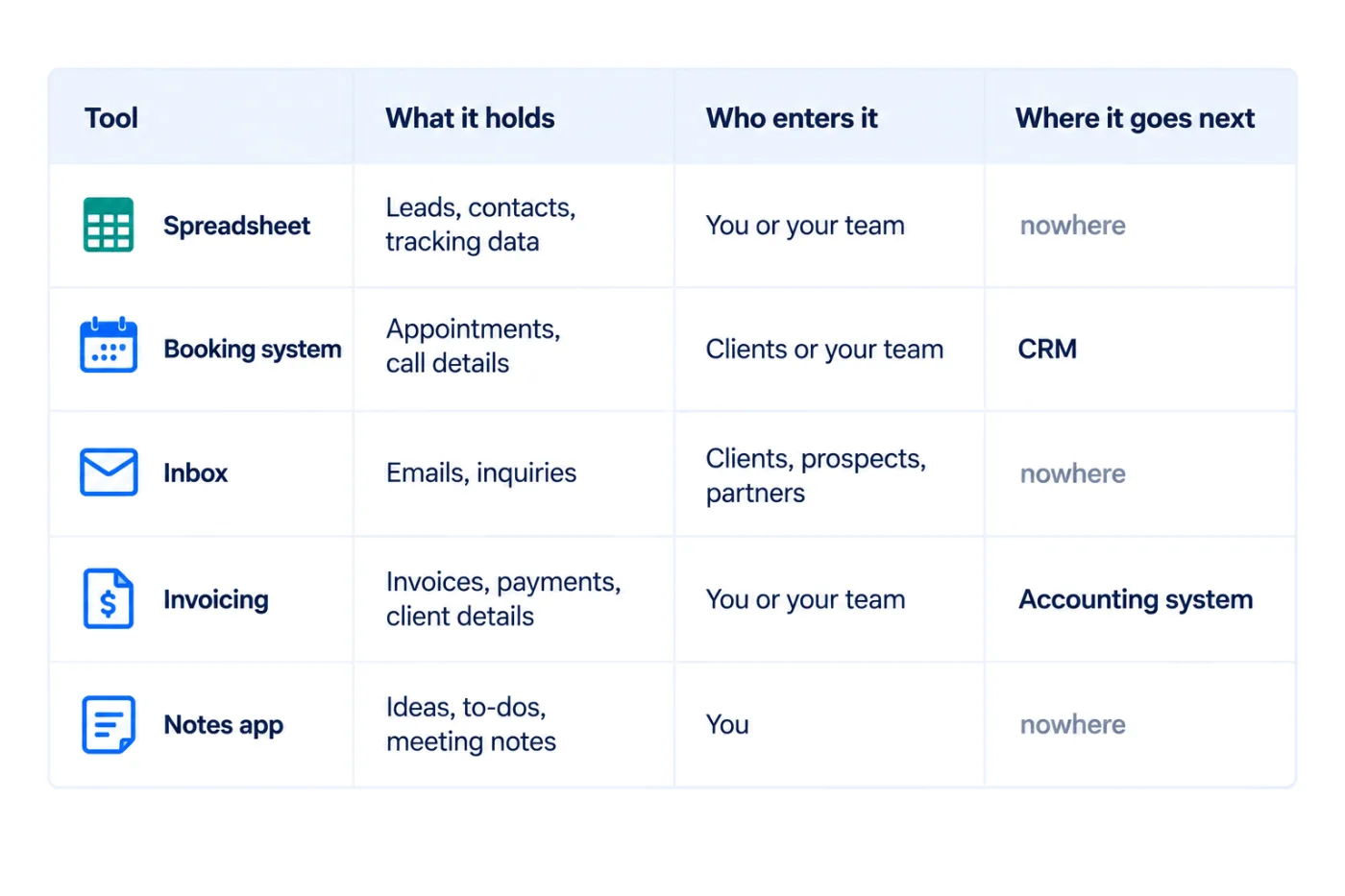
3. Find the duplicates. Which systems hold a version of the same thing? Customers, invoices, appointments, leads. For each, decide which one is authoritative. Not which one is nicest. Which one is the truth when two disagree.
That single decision, made explicitly and written down, resolves more confusion than any integration.
4. Mark the manual hops. Every place a human moves data from one system to another. These are your automation candidates, and now you can rank them by how often they happen and how badly they hurt when they go wrong.
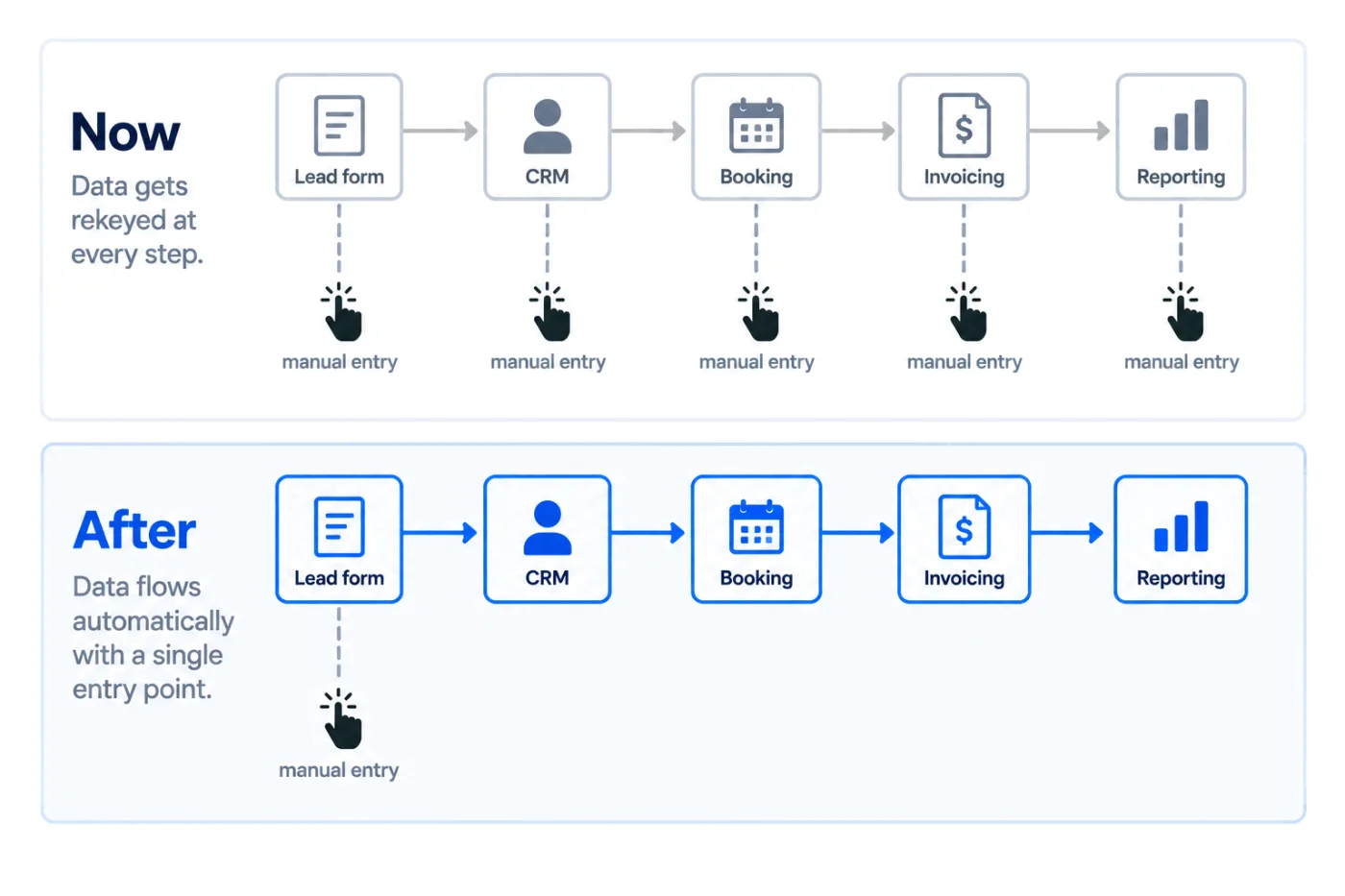
5. Then, and only then, connect things. Starting with the single most painful hop. One at a time, each one verified before the next.
What to expect at the end
The output is not a diagram for the wall. It is a short list you can act on:
- The systems you are paying for and no longer use. Cancel them.
- The one place each kind of record officially lives.
- The three or four manual steps costing the most time.
- What has to be true before any of it can be automated.
The last item is usually the most valuable and the least welcome. Frequently the answer is that two systems have to agree on what a customer record looks like before anything else can happen, and that is unglamorous cleanup work with no demo at the end.
The part people skip
The inventory is not the hard part. The hard part is deciding, out loud and in front of everyone, which system wins when two disagree.
That decision has politics in it. Somebody chose the losing system. Somebody has been maintaining the spreadsheet for three years and is proud of it, correctly, because it has been holding the business together.
Doing this well means being clear that the spreadsheet was the right answer to a real problem, and that the goal is to stop needing a person to be the integration layer.
The short version
Do not start by connecting things. Start by listing them, deciding what is authoritative, and finding the manual hops. Integration is the last step, not the first.
If you would rather have someone external do the inventory and the ranking, a Business Technology Audit is exactly this exercise, with the awkward questions asked by somebody who has no history with any of the tools. Being an outsider is most of the value.