Yoast is installed on millions of WordPress sites and configured properly on very few of them. Most people run the setup wizard, watch for green lights, and never open the settings again. The green light is the least useful thing in the plugin.
This is what to actually set, what to leave alone, and what the plugin does not do no matter how green it goes.
Updated September 2026.
What Yoast is and is not
Yoast is a metadata manager. It controls what search engines are told about your pages: titles, descriptions, canonical URLs, indexing directives, structured data, sitemaps, and what a link to your page looks like when someone shares it.
It is very good at that. It is not an SEO strategy, it does not judge whether your content is worth reading, and installing it changes nothing on its own. A site with Yoast configured perfectly and nothing worth ranking for will not rank.
That is worth saying plainly, because the green light implies otherwise.
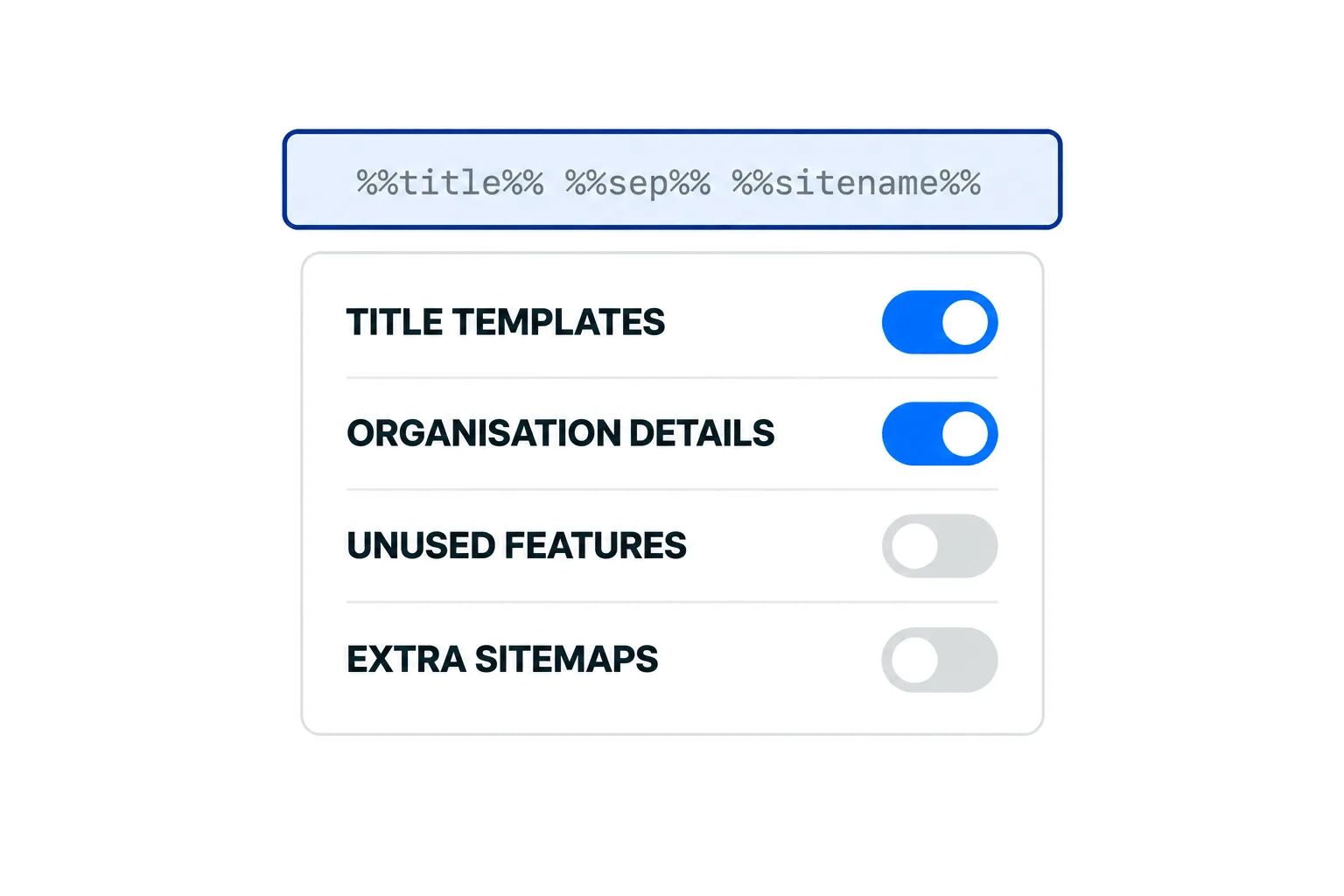
First: fix your title templates
This is the highest value setting in the plugin and it is buried.
Go to Yoast SEO, Settings, Content Types. For each content type, there is a title template controlling every page of that type at once.
The default for posts is usually the post title plus the site name. That is fine. The defaults that need attention:
- Pages often inherit a template that adds your site name twice. Check it.
- Categories and tags frequently produce titles like "Plumbing Archives - Smith Plumbing". Rewrite to something a person would click.
- Author archives, if you are a one person business, are duplicate content of your blog listing. See below.
Fixing templates fixes hundreds of pages in one edit. It is the single best use of ten minutes in this plugin.
Second: turn off what you do not use
WordPress creates archive pages for things you may not have. Every one of them is a thin, near-duplicate page that Google may index.
In Settings, Advanced, Archives:
- Author archives: turn off if you are the only author. It duplicates your blog page exactly.
- Date archives: turn off. Almost nobody has a legitimate use for these.
- Format archives: turn off. Very few themes use post formats meaningfully.
In Settings, Advanced, Media, make sure attachment URLs redirect to the file. Yoast does this by default now, but on sites upgraded from older versions it is sometimes still off, and it is a classic source of hundreds of junk pages.
In Content Types, set anything you do not want in search to "No" under "Show in search results". Tags are the usual candidate on a small site.
Third: fill in the organisation details
Settings, Site representation. Choose organisation or person, add the name, add a logo, add your social profiles.
This populates the structured data that Yoast outputs on every page. It is what feeds the knowledge panel and what other tools read to work out who you are. It takes two minutes and most sites leave it blank.
If you are a local business with an address and hours, that lives in the Local SEO add-on rather than the core plugin.
Fourth: write real meta descriptions where it counts
Yoast will generate a description from your content if you leave the box empty. That is acceptable for the long tail and a waste on your important pages.
Write descriptions by hand for your home page, your service pages, and your five most visited posts. Everything else can be automatic.
A description is an advert, not a summary. Around 155 characters, saying what the reader gets, and containing the phrase they searched for because Google bolds it.
What to ignore
The traffic light. It scores keyphrase density, subheading distribution and a handful of mechanical checks. It cannot tell whether the page is any good, and optimising to make it green produces the repetitive, keyword-stuffed writing that everyone recognises immediately.
Use it as a checklist glance, not a target. Orange is fine. Orange is frequently better than green.
The readability analysis. It is built on rules that suit some writing and actively damage other kinds. Long sentences are not a defect. Passive voice is sometimes the correct choice. If you write clearly, ignore it.
Cornerstone content, unless you are actively using the internal linking suggestions in Premium. On its own it does very little.
The keyphrase field itself, as a ranking mechanism. It tells Yoast what to check against. It tells Google nothing. Setting a keyphrase does not target anything.
Is Premium worth it
Premium runs at roughly $119 a year for one site, and the answer depends entirely on one feature.
The redirect manager is the reason to buy it. When you change a URL or delete a page, Yoast catches it and offers to set up the redirect. On a site where content moves, that single feature prevents the most common and most expensive SEO mistake there is: quietly breaking every link to a page that used to rank.
The rest is nice rather than necessary. Multiple keyphrases, internal linking suggestions, orphaned content detection, bulk metadata generation, 24/7 support, and the Local, Video and News add-ons bundled in.
Buy Premium if you publish and reorganise regularly, or if you are about to restructure the site. The redirect manager alone justifies it during a migration.
Skip it if the site is stable, small, and you are comfortable managing redirects at the server or with a free redirect plugin. The free version handles metadata perfectly well.
What Yoast will not fix
Worth being clear about, because people install it expecting more:
- Site speed. Different problem, different tools.
- Thin or duplicate content. Yoast can hide it from search. It cannot make it worth reading.
- Missing pages. If you do not have a page about the service, no plugin creates the ranking for it.
- Backlinks. Nothing on your own site produces those.
- Local rankings. Those come mostly from your Google Business Profile, not from your website.
The ten minute version
If you do nothing else:
- Check and fix the title templates for pages, categories and tags.
- Turn off author, date and format archives.
- Fill in Site representation.
- Write meta descriptions by hand for your home page and service pages.
- Ignore the traffic light.
That covers the majority of what Yoast is actually for, and it is more than most sites running it have ever had done.